2 авг. 2011 г.

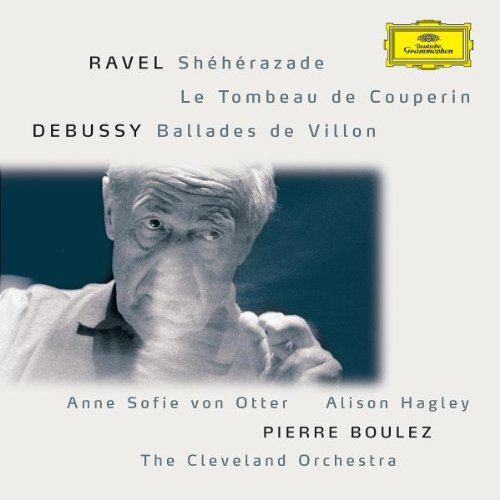
Ravel - Shéhérazade, Le tombeau de Couperin, Pavane, Menuet antique / Debussy - Danses. Trois ballades de François Villon. Boulez, Otter. ape

                               Дирижирует Пьер Булез:
    Морис Равель - Шехерезада, Гробница Куперена, Павана, Менуэт
 Клод Дебюсси - Танцы священные и мирские, Поэма Бодлера, Три баллады Франсуа Вийона

MAURICE RAVEL (1875-1937)
 

Shéhérazade - Sur des Vers de Tristan Klingsor
1. Asie
2. La flûte enchantée
3. L'indifférent
Le tombeau de Couperin - Orchestral version
1. Prélude
2. Forlane
3. Menuet
4. Rigaudon
Pavane pour une infante défunte - Orchestral version
Menuet antique - for Orchestra


CLAUDE DEBUSSY (1862 - 1918)

Danses for Harp and Orchestra
1. Danse sacrée
2. Danse profane
Poèmes de Charles Baudelaire
Le jet d'eau 
Trois ballades de François Villon
1. Ballade de Villon à s'amye
2. Ballade que Villon fait à la requeste de sa mère pour prier Nostre Dame
3. Ballade des femmes de Paris

Anne Sofie von Otter, mezzo-soprano
Alison Hagley, soprano
Lisa Wellbaum, harp
THE CLEVELAND ORCHESTRA / PIERRE BOULEZ


http://files.mail.ru/4IOW9P

Marcel Landowski - Concertos. Symphonies 1, 3 & 4. France Clidat, Jeanne Loriod, Jacques Houtmann, Georges Prêtre. flac

                    
Марсель Ландовский - Концерты для фортепиано, флейты, тромбона и волн Мартено с оркестром
Симфонии №№ 1, 3, 4. Дирижёр - Жорж Претр

Marcel Landowski (1915-1999)

Concertos

Concerto pour piano et orchestre n° 2 (1963)

Concertino pour trombone et cordes (1990)

Concerto pour flûte et orchestre à cordes (1968)

Concerto pour ondes Martenot (1954)

France Clidat, piano
Michel Becquet, trombone
Alain Marion, flute
Jeanne Loriod, ondes Martenot
Philharmonie de Lorraine
Jacques Houtmann, cond


Symphonies 1, 3 & 4

Symphonie n° 1 “Jean de la Peur” (1949)

Symphonie n° 3 “Des espaces” (1965)

Symphonie n° 4  "l'horloge" (1988)

Orchestre National de France
Georges Prêtre, cond.


http://files.mail.ru/LGNCSW

Saint-Saens - Requiem. Psaume XVIII. Pollet, Chalmeau-Damonte, J.Mercier. ape+covers


                              Сен-Санс - Реквием, XVIII псалом.

Camille Saint-Saens (1835-1921)

Requiem, op.54
1. Kyrie
2. Dies Irae
3. Rex Tremendae
4. Oro Supplex
5. Hostias
6. Sanctus
7. Benedictus
8. Agnus 

Psaume XVIII, Coelli enarrant, op.42
9. Introduction Et Choeur
10. Solo Et Choeur
11. Recit
12. Choeur
13. Duo
14. Quatuor
15. Quintette Et Choeur
16. Sextour
17. Air
18. Final

Françoise Pollet
Magali Chalmeau-Damonte
Jean Luc Viala
Nicolas Rivenq
Orchestre National d'Ile de France
Jacques Mercier, cond


http://files.mail.ru/7O4B41

Prokofiev - Pierre et le Loup / Saint-Saens - Le Carnaval Des Animaux/ Poulenc - Histoire de Babar. Markevich, Ciccolini, Pretr. flac


Сергей Прокофьев - Петя и волк. (Питер Устинов, Игорь Маркевич)
Сен-Санс - Карнавал животных. (Альдо Чикколини, А.Вайссенберг, Ж.Претр)
Пуленк - История слонёнка Бабара. (Клод Пьеплю, Ж.Претр)

Serge Prokofiev
1. Pierre et le Loup

Peter Ustinov, narrator
Orchestre de Paris, cond. - Igor Markevitch


Camille Saint-Saens

2-10. Le Carnaval Des Animaux

A.Ciccolini, A.Weissenberg - pianos

Francis Poulenc
11. L'histoire De Babar, Le Petit Éléphant

Claude Piéplu, narrator
Orchestra de la Société des Concerts du Conservatoire
Georges Pretre, cond


http://files.mail.ru/CE78EO

Rodrigo - Concerto de Aranuez, Fantasía para un gentilhombre / Falla / Chabrier. Bonell, Dutoit, ape+covers


                                  Дирижирует Шарль Дютуа:
Хоакин Родриго - Концерт Аранхуэс, «Фантазия для благородного рыцаря»
Мануэль де Фалья - 3 танца из балета "Треуголка" .
Эммануэль Шабрие - "Испания"


Joaquin Rodrigo - Concerto de Aranuez
1. Allegro con spirito
2. Adagio
3. Allegro gentile

Manuel de Falla - 3 Dances from "El Sombrero de Tres Picos"
I. The Neighbours
II. The Miller's Dance
III. Final Dance

Joaquin Rodrigo  - Fantasía para un gentilhombre
1. Villano y Ricercare (Adagietto - Andante moderato)
2. Españoleta y Fanfare de la Caballería de Nápoles (Allegretto molto ritmico)
3. Danza de las hachas (Allegro con brio)
4. Canario (Allegro ma non troppo)

Emmanuel Chabrier - Espana

Carlos Bonell, guitar
Orchestre Symphonique de Montreal
Charles Dutoit, cond.


http://files.mail.ru/Y2K79O

28 июл. 2011 г.

Ravel - L'Enfant Et Les Sortileges, L'Heure Espagnole / Debussy: Le Martyre De Saint Sebastian. Ansermet, OSR. ape+covers

Дирижирует Эрнест Ансерме: 
Морис Равель (1875-1975) - Дитя и волшебство, опера-балет (1925) 
 Испанский час, опера (1907)
Клод Дебюсси (1862-1918) - Мученичество св.Себастьяна (1911)

Ernest Ansermet's approach to L'Enfant et les Sortilèges highlights the perspective of the Child. The opening motif for two oboes, for example, is meandering and annoying, perfectly reflecting the Child's boredom and peevishness. The extreme eccentricities of the apparitions are heard in high relief, emphasizing the individuality of the vocal lines and the stunning clarity of the orchestral details. There is nothing pastel about Ansermet's reading; his ability to bring out the score's nightmarish qualities and to make the wild sections sound dangerously out of control is revelatory. All the singers excel, giving vividly characterized and vocally accomplished performances. This is altogether one of the most exciting recordings of the opera available.
Ravel's only other opera, L'Heure Espagnole, is less well known, but has many charms -- an amusing plot, vivacious music, and Ravel's characteristically brilliant orchestration. The libretto, however, doesn't seem to have inspired the composer as much as Colette's for L'Enfant, and much of the vocal writing is on the level of pleasant but unmemorable arioso. The characterizations of soloists Suzanne Danco, Paul Derenne, Michel Hamel, and Heinz Rehfuss are sharply and amusingly etched, and the singing is warm and idiomatic.
Debussy's incidental music for Gabriele d'Annunzio's play Le Martyre de Saint Sébastien is one of the composer's most substantial works, and the hour-long suite presented here consists of five excerpts assembled by André Caplet. The suite contains some of the composer's lushest and most highly perfumed music. If the listener can persevere through the sadistic pseudo-Christian mysticism of d'Annunzio's text, there is music of much delicacy, eloquence, and grandeur, and the vocal writing is especially evocative and expressive. The soloists don't convey the innocence and purity to be fully convincing, and at the end of an extended unaccompanied section notable for their perilous intonation, they face a dire tonal collision when the orchestra reenters. Ansermet's reading seems to plod when it should float, and generally fails to bring out the score's mystery and majesty. Ansermet's stolid interpretation, with the pallid orchestral playing and strained choral singing, make this performance seem very much out of place on an otherwise excellent set. The sound quality is generally good, with little tape noise, and the sound in L'Enfant et les Sortilèges is notable for the clarity with which it captures the rich and varied orchestral timbres.

CD1    Ravel: L'Enfant Et Les Sortileges
    1    Part 1. J'ai pas envie de faire ma page           
    2    Part 1. Votre serviteur humble, Bergиre           
    3    Part 1. Oh! ma belle tasse chinoise!           
    4    Part 1. Ah! c'est Elle! c'est Elle!           
    5    Part 1. Deux robinets coulent dans un rйservoir!           
    6    Part 2. Ah! quelle joie de te netrouver, Jardin!           
    7    Part 2. Danse des reinettes           
    8    Part 2. Ah! c'est l'Enfant au couteau!
Debussy: Le Martyre De Saint Sebastian       
    9    Act 1. La Cour des lys           
    10    Act 2. La Chambre magique           

CD2    1    Act 3. Le Concile des faux dieux           
    2    Act 4. Le Laurier blessй           
    3    Act 5. Le Paradis
Ravel: L'Heure Espagnole           
    4    Introduction. Seсor Torquemada, horloger de Tolиde?           
    5    Il reste, voilа bien ma chance!           
    6    Salut а la belle horlogиre!           
    7    Monsieur, ah! monsieur!           
    8    Oh! la pitoyable aventure!           
    9    Il n'est, pour l'horloger, de joie йgale...


Flore Wend, Marie-Luise de Montmollin, Geneviève Touraine, Adrienne Migliette, Suzanne Danco, Juliette Bise, Gisèle Bobillier, Lucien Lovano, Pierre Mollet, Hugues Cuénod  

Suzanne Danco, Nancy Waugh, Marie-Luise de Montmollin

Suzanne Danco, Paul Derenne, Michel Hamel, Heinz Rehfuss, Andre Vessieres etc

L'Orchestre de la Suisse Romande / Ernest Ansermet 

http://files.mail.ru/2T1K0P

Chausson / Roussel / Magnard - String Quartets. Quatuor Via Nova. (WARNER APEX - 2 CD,ape,covers)

  Шоссон, Руссель, Маньяр - Струнные квартеты. Исполняет квартет "Via Nova"

Three French string quartets in idiomatic performances and vivid recordings.
You may well be familiar with these recordings from the Erato stable. Bless Warners for giving them a new lease of life at a price unimaginably attractive when these were first issued. The set has many virtues and the performances are completely consonant with the inherent character of the music. None of these works are exactly common and I certainly hope that collectors will be tempted to chance their arm for an experimental listen.
The Chausson is bathed in a late-romantic warmth, an aura glows over the contours of the themes. There is a most lovely Très Calme middle movement ending with a sigh. The Via Nova project inwardness and concentration. The quartet was left incomplete when Chausson died as a result of a cycling accident. He had completed the first two movements and most of the third. D'Indy finished the work from Chausson's sketches giving it a superb and blazingly affirmative finale. It works very well as a mood-piece although the lyrical themes lack strongly memorable character.
The Roussel is the latest work here. It is from his neo-classical phase. There are four movements. Roussel died in the Atlantic resort of Royan in 1927 five years after completing this quartet. Chaffing vigour, impudence, even brashness are to be found here. There is a mesmerising adagio reaching back to the Chausson Très Calme and to Schubert's String Quintet.
The Magnard dwarfs the other two quartets both in duration and in mastery of expression. It is much closer in style to the Chausson than to the Roussel although the busy rhythmic interest of the Sérénade sometimes seems to look forward to Roussel. Magnard has less of a tendency to luxuriate in the warmth of the writing. There is a more lively feeling to the writing with plenty of variety and active detailing. The third movement is a Chant Funèbre; it breathes tragedy and the memory of days gone by. At the end of the movement the music glistens with silvery magic. The finale is called Danses. The contrapuntal riches continue, threaded through with Franckian melos and mixed with the mystery of the late quartets of Beethoven. The approach remains committedly late-romantic.

Chausson / Roussel / Magnard - String Quartets

Ernest CHAUSSON (1855-1899)
String Quartet in C minor Op. 35 (completed by Vincent d'Indy) (1900) [30.39]
I. Grave (13:20)
II. Tres calme (8:44)
III. Gaiement et pas trop vite (8:35)
 

Albert ROUSSEL (1869-1937)
String Quartet in D major Op. 45 (1932) [20.48]
I. Allegro (4:16)
II. Adagio (6:55)
III. Allegro vivo (2:50)
IV. Allegro moderato (6:47)

Albéric MAGNARD (1865-1914)
String Quartet in E minor Op. 16 (1903) [43.17] 
 I. Sonate (14:24)
II. Serenade (6:50)
III. Chant funebre (11:18)
IV. Danses (11:46)

Quatuor Via Nova: 
Jean Mouillère, Hervé le Floch (violins); Gerard Caussée (viola); 
René Benedetti (cello) (Chausson, Roussel). 
Jean Mouillère, Jean-Pierre Sabouret (violins); Claude Naveau (viola); 
Jean-Marie Gamard (cello) (Magnard).
rec. Studio 106, Radio France, Oct 1985 (Magnard); 1970, DDD, ADD